Geomarketing 101: What It Is, How It Works, and Why It Drives Real Sales
Reading time: 10 minutes

Geomarketing is the art of putting your ads in front of the right audiences, built from their real movement in the physical world. Instead of guessing who might be interested, you reach people based on the places they actually go. And depending on your goal, you measure what matters: awareness (reach, brand awareness), interest (clicks, visits to your site and online store), or real store visits.
Geomarketing is still programmatic digital advertising, delivered across a broad inventory: display, video, native, audio, and connected TV. Its strength is not any single channel, it is the precision of the targeting: the right audience, real, at the right moment. Depending on your goals, it lets you reach as many people as possible, go after your competitors' customers, or bring your audience to visit your sites, buy online, or come to your store.
At Propulso, this has been our craft for over a decade, with more than 2,400 customers across North America. This article explains what geomarketing is, how it works, what it is used for, and how to get started without unnecessary complexity.
What is geomarketing, exactly?
Geomarketing brings together two things: location data (where people go, how often, and from which areas) and advertising action (which audience to target, where to focus budget, how to measure results). You will also hear it called location intelligence or location-based marketing. The core idea stays the same: turn real movement into real decisions and real outcomes.
What sets geomarketing apart from classic advertising is its raw material. Traditional advertising relies on declared intent, loose interests, or cookies that are disappearing. Geomarketing relies on observed behavior: the places people genuinely visit. That signal is more reliable, and much closer to a purchase.
Geomarketing, geolocation, and geofencing: what is the difference?
These three terms often get mixed up. Here is a simple way to separate them.
- Geolocation is the underlying technology: locating a mobile device in space. It is the foundation, not a strategy.
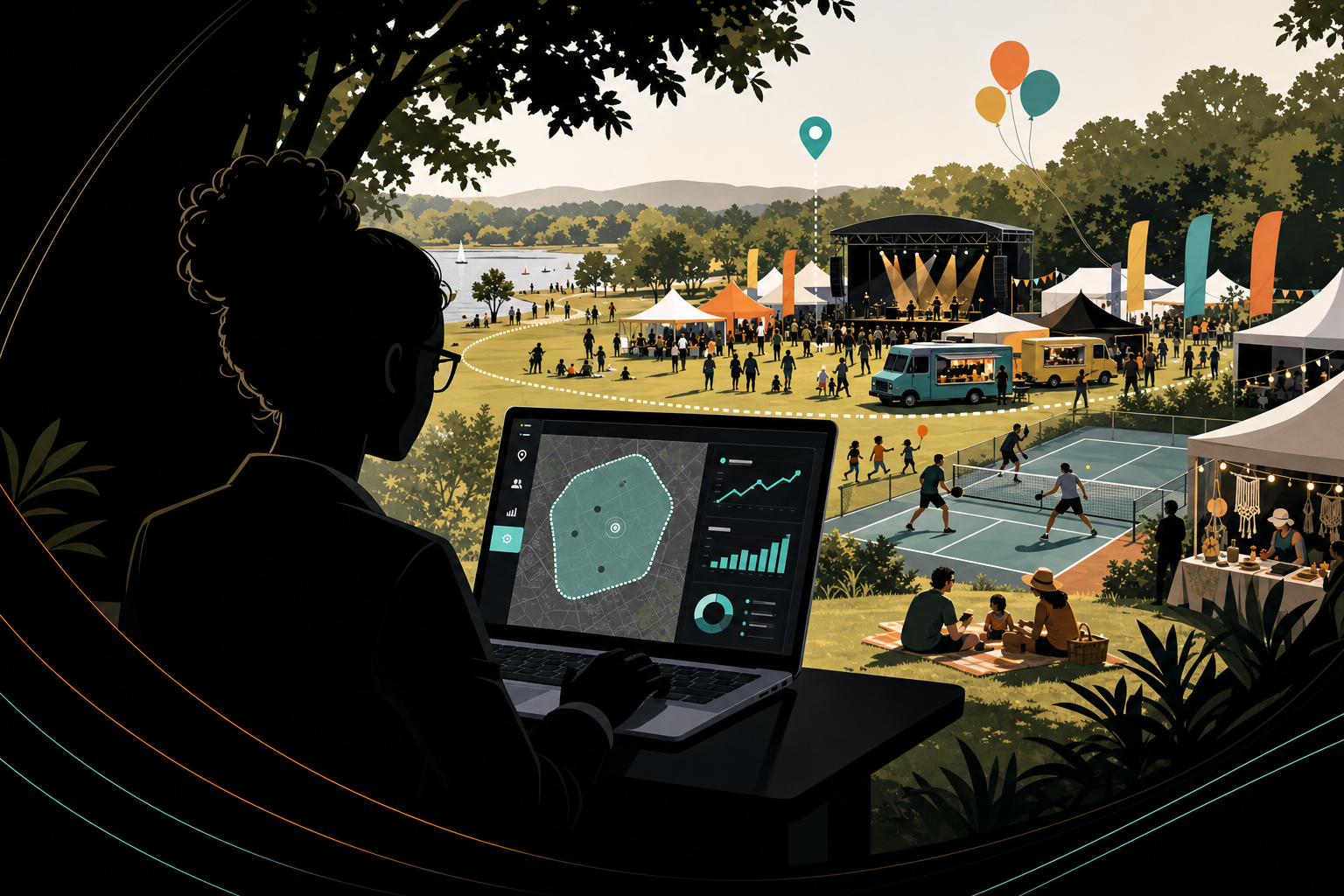
- Geofencing means drawing a virtual perimeter around a specific place: your store, a retail district, an event, or a competitor. You can then reach people who enter that perimeter, or who visited it recently.
- Geomarketing is the full discipline that wraps around all of this: strategy, targeting, ad delivery, and measurement. Geofencing is a tool. Geomarketing is the approach.
How does geomarketing work?
Geomarketing rests on four simple steps.
First, the collection of anonymized location signals that reveal aggregated consumer movement across a region. At Propulso, these signals carry historical depth of up to two years, which lets you understand seasonal trends, not just the present moment.
Next, the definition of an audience from that behavior. You can target visitors to a type of place (campgrounds, malls, dealerships) or a precise geographic area.
Then comes delivery: your ads are served to that audience, alongside what you already run elsewhere.
Finally, measurement, based on the goal you set. Geomarketing is evaluated on several metrics: reach and awareness at the top of the funnel, clicks and online visits in the middle, and all the way to store visits at the bottom. This last measure, rarer on the market, connects an ad exposure to a real visit (we explain it in Beyond ROAS).
The real strength of geomarketing: targeting real audiences
Whatever the goal, everything rests on one thing: the precision of the audience you put your ads in front of. That is the strength of geomarketing. You do not start from an assumed profile, but from real behavior: the places people genuinely go.
From there, you choose your goal, and the right metrics follow.
| Goal (stage) | What you aim for | Metrics to track |
| Awareness (top of funnel) | Be seen by as many of the right people as possible | Reach, impressions, cost per thousand (CPM), brand awareness |
| Interest (middle) | Spark attention and online action | Click-through rate, clicks, visits to your site and online store, video views, audio listens, cost per lead |
| Action (bottom of funnel) | Drive a concrete action | Cost per action (in-store or online), online conversions, attributed store visits, incremental visits, cost per visit |
What is a trade area, and why it matters
A trade area is the territory your customers truly come from. It is not a fixed radius drawn at random on a map. It is the real pull zone of your location, calculated from observed movement.
Defined well, it answers very concrete questions. Where do your customers come from? How far will they travel to reach you? Which areas underperform against their potential? Where should you open next? It is the basis of any serious location decision.
Reach the right audience, then measure the right goal
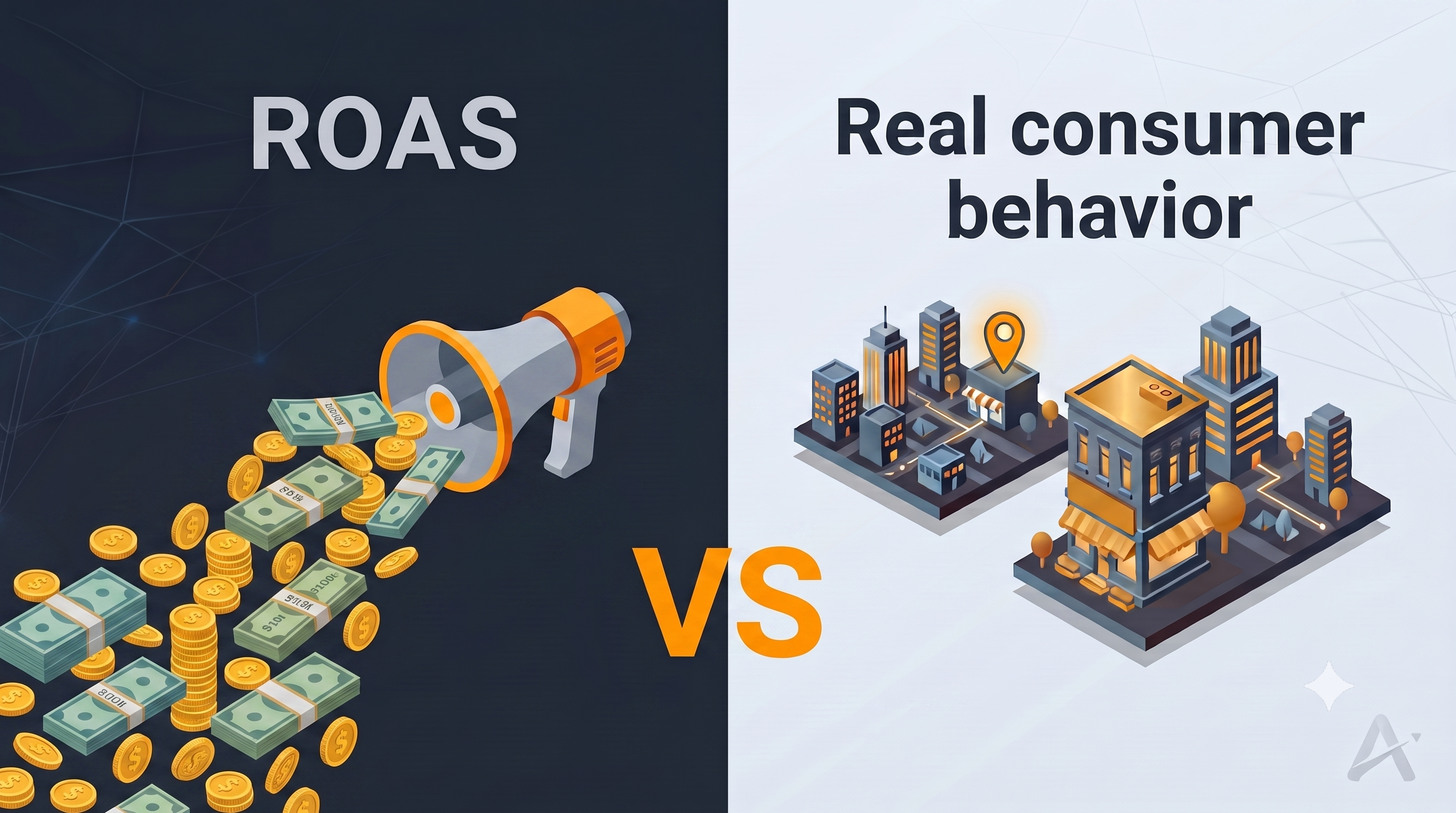
Most platforms measure what happens on a screen: impressions, clicks, online conversions. That is useful, but incomplete. What it adds, and few others offer, is the ability to connect a campaign to real store visits, when that is the goal you are after. When 76% of people who search for something nearby on their phone visit a business within a day (source: Think with Google), you can see that the real world counts as much as the screen. So the right question is not only "how many clicks," but "did we reach the right audience, and get the result we set out for," whether that is awareness, web traffic, or store visits.
What is geomarketing used for, in practice?
Geomarketing applies to any business or organization whose success is measured in the real world.
For retail, it drives store traffic and reveals high-potential areas. For restaurants and hospitality, it targets visitors to tourist zones, events, or seasonal locations. For automotive, it reaches in-market buyers around competing dealerships. For real estate and site selection, it backs a location choice with behavioral data instead of a hunch. For business districts and cities, it measures foot traffic on a street or the impact of an event.
The common thread: in every case, you replace a guess with a measurement.
A few concrete examples
Restaurant
Car dealership
Retailer
Coffee shop or quick-service
Fitness center
Hotel or attraction
Does geomarketing replace Google and Meta?
No, and it matters to say so clearly. Geomarketing does not replace your Google, Meta, or ad-buying platform campaigns. It adds to them.
Google and Meta are excellent at capturing intent and the click. Geomarketing adds a layer they cannot offer: targeting based on real movement and measurement all the way to store visits. You keep what already works, and you add real-world proof on top. It is an addition, not a replacement.
How much does geomarketing cost?
Cost depends on the buying model and the scale of the campaign. In location-based advertising, cost per thousand impressions (CPM) usually ranges from 8 to 25 dollars, higher than an ordinary banner, but with far greater relevance and measurement. For a single-location business, a starting budget of about 500 to 1,000 dollars per month is already enough to test seriously (figures are indicative).
The right cost indicator depends on your goal: CPM and reach for awareness, click-through rate and cost per click for interest, cost per visit for store traffic. Choose the one that matches the result you are after.
Want to see what this looks like for your business? Book 15 minutes with a Strategist.
Where to start
You do not need a full overhaul to begin. The right way to start comes down to a few steps.
Start with your business goal: promote an offer, bring traffic back to your store, get customers to return, reach a new clientele, build loyalty, or drive people to your website and online store. That goal sets your metrics: awareness, reach, clicks, new-prospect acquisition, online visits, or store visits.
Then define your audience: one or more precise audiences, for example consumers who have visited your competitors, those who frequent the places around your store, or those who have already come to see you.
Then launch a first campaign on a modest budget, measure the result that matches your goal, and reinvest where it is strongest. With geomarketing, you can go broad or narrow. The key is to start from a real audience.
With Propulso, you can start self-serve in under thirty minutes, or work with our team to build your first campaign together.
Frequently asked questions
Is geomarketing privacy-friendly?
What is the difference between geomarketing and location-based advertising?
Does geomarketing work for small businesses?
How do you measure the success of a geomarketing campaign?
In short
Geomarketing turns your customers' real movement into real outcomes. It complements your existing channels, proves its impact on the goal you choose, from reach all the way to the store visit, and gives every dollar a clear direction.
👉 The logical next step: see how to capture the summer high season and how to measure real visits beyond ROAS. And if you want to talk it through, our team can build your first campaign with you.
Ready to move from reading to results? Book a demo with a Strategist.